
Overview
This itinerary has been designed to maximise wildlife photography opportunities at every turn — while maintaining a pace that is enjoyable, sustainable
Itinerary
UGANDA WILDLIFE PHOTOGRAPHY SAFARI
A Relaxed, Immersive Wildlife Photography Experience
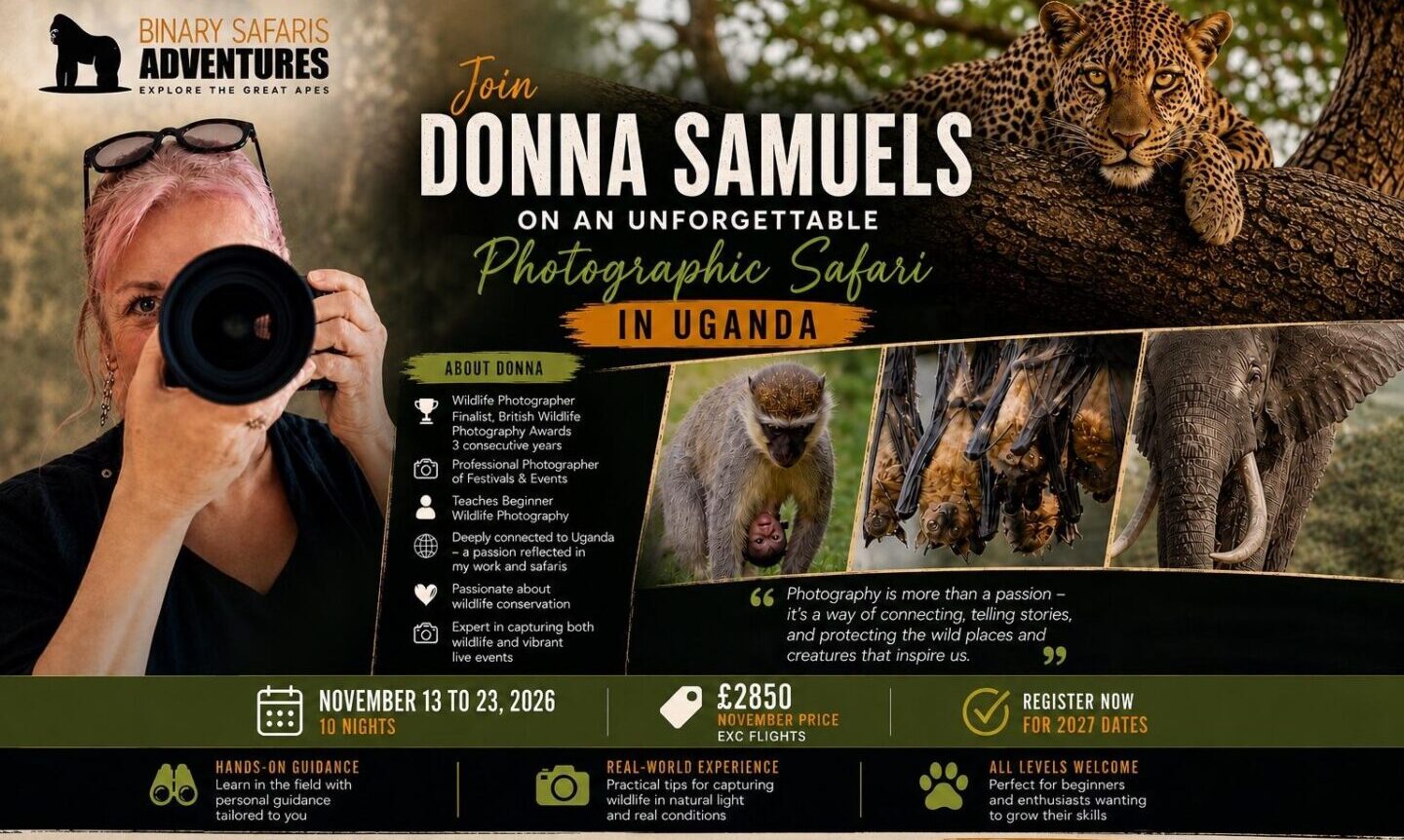
Curated and led by Donna Samuels | Wildlife Photographer
11 Days / 10 Nights | in conjunction with Binary Safaris Adventures
About This Tour & Your Host
This safari has been conceived and created by Donna Samuels, Wildlife Photographer, with one clear purpose: to give a small group of like-minded wildlife photography enthusiasts the holiday of a lifetime in one of the world’s most extraordinary and unspoiled natural landscapes. It has been designed with over 50s in mind but is not limited to any age group.
Uganda is a country of breathtaking beauty and staggering biodiversity — and yet it remains refreshingly uncrowded compared to the well-worn safari circuits of East Africa. This is a place where you can spend an hour with a family of chimpanzees in ancient rainforest, watch tree-climbing lions at dawn, drift silently through papyrus swamps in search of the Shoebill Stork, and return each evening to a lodge where kingfishers flash past your veranda and fruit bats fill the sky at sunset. Uganda is, quite simply, one of the great wildlife photography destinations on earth.
Donna has designed this tour with a very specific group in mind: passionate wildlife photographers of all levels who want to share that passion in a warm, non-competitive, and genuinely supportive atmosphere. A group of people who love wildlife and love photography, exploring one of Africa’s most spectacular countries together at a pace that allows everyone to breathe, to look, and to get the shot.
For those who are newer to wildlife photography or less confident with their camera settings, Donna will be on hand throughout the tour to offer guidance, share techniques, and ensure that every member of the group — whatever their experience level — comes home with photographs they are genuinely proud of.
The aim is that everyone gets the best possible opportunity from every situation and enjoys the experience
Your Tour Operator;
At Binary Safari Adventures, we pride ourselves on delivering authentic, well-crafted safari experiences that go beyond the ordinary. With our own fleet of 4×4 safari vehicles and a team of experienced local guides, we ensure comfort, reliability, and deep destination knowledge throughout your journey. Every itinerary is carefully designed with attention to detail, with our new wildlife Photography tour offering a perfect balance of wildlife encounters, primate tracking and carefully a curated itinerary allowing guests to truly connect with Uganda and its wildlife in a meaningful and memorable way. Licenced by The Ugandan Tourist board license number UTB/RTT/TT/2025/102136.
This is not just a safari. It is a shared photographic adventure — and the holiday of a lifetime.
IMPORTANT NOTE – This safari requires a minimum of 4 people to run so please wait until tour is confirmed before making any travel arrangements or buying any special insurance e.t.c.
Dates Nov 13th to 23rd. FLIGHTS NOT INCLUDED IN PRICE
NOTE -Direct flights from Uk depart by Uganda Airways from Gatwick Fri 13th Nov 2026 11.40 -Departure 1am( 24th nov ) ) 23rd Nov before transfer to airport at aprox 10.30pm -Day room and evening meal available for additional cost (approx $40) on 23rd Nov.
Cost £2850 per person – no single room supplement. Singles, Couples, Groups welcome.
Overview;
This itinerary has been designed to maximize wildlife photography opportunities at every turn — while maintaining a pace that is enjoyable, sustainable. The two are not in conflict: by choosing lodges and guesthouses specifically for their wildlife-rich gardens, positioning game drives at dawn and dusk for the best natural light, and spending two nights at each key location rather than rushing through, this safari delivers more photographic moments per day than a conventional circuit whilst feeling genuinely relaxed.
Every accommodation on this itinerary has been selected with photography in mind. From the bird-filled gardens of the Airport Guesthouse Entebbe to the fruit bat colony at Travellers Rest in Kisoro, guests need never be without a lens in hand — even between park visits. There is always something to photograph, always good light to find, and always time to wait for the shot.
The safari visits five distinct ecosystems — equatorial forest, open savannah, papyrus wetland, volcanic highland, and the shores of Lake Victoria — offering an exceptional range of habitats and subjects: chimpanzees, tree-climbing lions, hippos, elephants, forest birds, shoebill storks, kingfishers, fruit bats, and much more.
This itinerary is ideally suited to the over-50s traveller (not exclusively though!) and those photography enthusiasts of all skill levels, and anyone who values quality of encounter over the relentless pace of a traditional safari. A dedicated photography guide is with the whole tour. Note that Gorilla trek is not included on this tour. Gorilla Trekking can be arduous and costs approx. $800 per trek. Uganda has so much wildlife to offer. It may be possible for those who wish to do a Gorilla Trek to add this onto the end of the trip independently.
Safari At a Glance;
| Duration | 11 days / 10 nights |
| Start / Finish | Entebbe International Airport — base hotel: Airport Guesthouse Entebbe |
| Group Size | Small group recommended (6-10 participants) |
| Photography Level | All levels welcome – beginners guidance included |
| Best Seasons | June-September (dry) and December-February |
| Transport | Private 4WD safari vehicles – essential for park roads |
| Physical Level | Low-Moderate. Relaxed pace throughout |
Detailed Day-by-Day Itinerary
Day 1 Arrival — Entebbe | Group Assembly
Guests arrive at Entebbe International Airport throughout the day -those from Uk arriving late evening and make their own way — or are transferred — to the Airport Guesthouse Entebbe, our base for the first two nights. The guesthouse is just 10 minutes from the airport, offers free airport transfers at any hour, and has been chosen specifically for its beautiful bird-filled gardens: a gentle and immediately rewarding introduction to Ugandan wildlife.
The Airport Guesthouse is well regarded by birders and wildlife photographers, with guests regularly spotting kingfishers, sunbirds, weavers, hornbills, and Guinea Fowl in the grounds without stepping outside
the property. Rooms face the garden and most have a private porch — ideal for quiet observation on arrival.
Day 2 Entebbe Botanical Gardens & Guesthouse Grounds
Morning – Welcome Breakfast and group introduction in the garden. Outline of the full itinerary, safety briefing, and — for those new to wildlife photography — a relaxed equipment and camera settings session to prepare everyone for the days ahead. This is a social occasion as much as a briefing:
Photography focus: First garden bird opportunities — kingfishers, sunbirds, weavers in the guesthouse grounds. Camera settings overview for beginners.
A full day based at the Airport Guesthouse and in the nearby Botanical Gardens — a day to recover from international travel and the ideal soft introduction to Ugandan wildlife photography before the longer drives begin.
Early morning: Enjoy a Dawn photography session in the guesthouse gardens before breakfast. This is often one of the most productive sessions of the entire safari — the grounds come alive at first light and guests can practice in a completely relaxed setting just meters from their rooms.
Morning and early afternoon: Guided photography walk or independent exploration through Entebbe Botanical Gardens, a short taxi/walk from the guesthouse. Sitting on the shores of Lake Victoria, the gardens are home to Grey-cheeked Mangabey and Black-and-White Colobus monkeys, African Grey Parrots, multiple kingfisher species, Hadada Ibis, weavers, and sunbirds — all in an unhurried, accessible setting with photographic instruction throughout.
Late afternoon and evening: Return to the guesthouse for golden-hour photography in the gardens, followed by an image review and debrief over dinner.
Photography focus: Primates, forest birds, using natural light — an ideal practice day before the main safari begins
Day 3 Mabamba Swamp, then travel to Kibale Forest
An early start to make the most of the swamp in morning light, before the long drive west into Uganda’s interior.
Pre-dawn departure for Mabamba Swamp (approximately 1 hour from Entebbe). This UNESCO Ramsar wetland is one of the most reliable places in Africa to photograph the prehistoric-looking Shoebill Stork, alongside a remarkable array of kingfishers, herons, papyrus specialists, and waterbirds. An extended canoe session on the water gives photographers maximum time with the subject.
Late morning: Depart for Kibale Forest National Park.
Mabamba Swamp to Kibale Forest: approx. 300-350 km — allow 6 to 7 hours with a lunch stop en route (Fort Portal recommended)
Arrive late afternoon. Settle into camp and enjoy an optional short evening walk.
Photography focus: Shoebill Stork, kingfishers, papyrus waterbirds in golden morning light
Day 4 Kibale Forest National Park — Chimpanzees & Primates
A full day in Kibale, the self-styled ‘Primate Capital of the World’, with time for both structured tracking and relaxed camp photography.
Early morning: Photography walk in the grounds of the forest camp — an excellent opportunity to photograph the birds and primates that visit at dawn before the heat of the day.
Mid-morning: Chimpanzee tracking with Uganda Wildlife Authority guides. Kibale is home to over 1,500 chimpanzees and offers among the highest encounter success rates in Africa. The forest also holds 12 other primate species. Optional afternoon: Bigodi Wetland Sanctuary guided walk for forest birds and primates.
Overnight: Kibale Forest Camp, night 2 of 2.
Photography focus: Chimpanzees in natural forest habitat, forest primates, 350+ forest bird species
Day 5 Kibale to Queen Elizabeth National Park
After a final early morning photography session in the camp grounds, depart for Queen Elizabeth National Park.
Kibale to Queen Elizabeth NP (Mweya Peninsula): approx. 130-180 km — allow 2.5 to 3 hours. The scenic route passes through the crater lake district with views of the Rwenzori Mountains
Arrive late morning. Check in to Queen Elizabeth bush camp, then lunch at the camp.
Afternoon: First game drive in the park — Uganda Kob, elephants, buffalo, warthog, hyena, and a bird list exceeding 600 species. Late afternoon sunset drive.
Overnight: Queen Elizabeth bush camp, night 1 of 2.
Photography focus: African savannah species, big-sky sunset photography
Day 6 Queen Elizabeth NP — Sunrise Drive & Kazinga Channel Boat Cruise
A full day in one of Uganda’s most wildlife-rich parks, with two very different photography environments.
Pre-dawn: Sunrise game drive on the Kasenyi Plains — prime time for lions, leopard, and Uganda Kob in golden morning light. Return to camp for breakfast.
Mid-morning: Kazinga Channel boat cruise. The channel connecting Lakes Edward and George supports one of the highest concentrations of hippos on the continent, as well as Nile crocodile and outstanding waterbird photography from water level — one of the trip’s most memorable photography sessions.
Afternoon: Optional second game drive on the Kasenyi Plains or visit to Kyambura Gorge for chimpanzee sightings-Evening sunset game drive.
Overnight: Queen Elizabeth bush camp, night 2 of 2.
Photography focus: Lions at dawn, hippos at water level, wading birds, herds of buffalo
Day 7 Ishasha Sector — Tree-Climbing Lions
An early departure south through Queen Elizabeth NP to the Ishasha Sector — home to one of the most extraordinary and unusual wildlife photography subjects anywhere in Africa.
Queen Elizabeth (Mweya) to Ishasha Sector: approx. 80 km — allow 2 hours through the southern section of the park
The Ishasha Sector is famous for its remarkable population of tree-climbing lions, regularly found resting in the branches of large fig and acacia trees overlooking the Ntungwe River plain. This behaviour is unique in
Uganda and rare globally, and offers photographers a subject quite unlike anything encountered elsewhere on the safari.
The sector also holds large herds of Uganda Kob, elephant, topi, and a rich bird list. Afternoon and sunset game drive. Overnight at Topi Lodge.
Photography focus: Tree-climbing lions — among Africa’s most extraordinary and photogenic subjects
Day 8 Ishasha to Kisoro — Travellers Rest Hotel
A final early morning game drive in Ishasha for the tree-climbing lions in golden dawn light, then a scenic drive southwest into Uganda’s spectacular volcanic corner.
Ishasha to Kisoro (Travellers Rest Hotel): approx. 65 km — allow 1.5 to 2 hours through increasingly dramatic volcanic landscape
Arrive late morning at the Travellers Rest Hotel in Kisoro — one of Uganda’s most historically significant and atmospheric lodges. Originally built in the 1950s, it was famously used as a base by Dian Fossey throughout the 1960s during her early gorilla research, and the history of the place is palpable.
For wildlife photographers, the hotel grounds are outstanding. A large colony of Straw-coloured Fruit Bats roosts in the tall trees alongside the property, providing spectacular photographic opportunities — particularly around dusk when the bats emerge in their thousands, silhouetted against the volcanic sky. The manicured gardens are alive with birds, with ibis, sunbirds, starlings, and weavers easily photographed from the terraces.
The setting itself is extraordinary: the hotel sits at the foot of the Virunga volcanoes, with the peaks of Muhavura, Gahinga and Sabinyo forming a dramatic backdrop. Late afternoon photography session in the grounds and gardens. Overnight at Travelers Rest Hotel, night 1 of 2.
Photography focus: Fruit bat colony at dusk, garden birds, dramatic volcanic mountain backdrop
Day 9 Kisoro — Full Day at Travelers Rest & Virunga Landscape
A full day based at Travellers Rest — the most relaxed and creatively rich day of the entire safari. With no driving required, photographers can focus entirely on the extraordinary subjects on their doorstep.
Dawn: Early morning photography in the hotel gardens as the mist lifts from the volcanoes — one of the most atmospheric shooting conditions of the trip. The garden birds are active from first light.
Morning: Optional guided walk to Lake Mutanda (approximately 3 km from the hotel) — a strikingly beautiful crater lake framed by the Virunga volcanoes, with dugout canoes on the water and local fishermen providing compelling foreground subjects. Outstanding landscape and wide-angle photography.
Afternoon: Rest and image editing, followed by the evening bat emergence — plan to be in position in the garden at least 30 minutes before sunset. As the light drops over the volcanoes, the fruit bat colony takes flight in their thousands, creating a spectacle that is genuinely one of the most dramatic wildlife photography moments available anywhere in East Africa.
Overnight: Travelers Rest Hotel, night 2 of 2.
Photography focus: Fruit bat colony emergence at sunset, Lake Mutanda landscape, volcanic skyline, garden birds at dawn
Day 10 Kisoro to Entebbe — Final Drive & Botanical Gardens
An early departure from Kisoro for the long but scenic return drive to Entebbe, arriving in time for a late afternoon photography session and the farewell dinner.
Kisoro to Entebbe (Airport Guesthouse): approx. 500 km — allow 7 to 7.5 hours including a lunch stop en route. The route passes through Kabale, Mbarara and Masaka — a rewarding drive through the Ugandan highlands and Lake Victoria basin
Depart Kisoro after an early breakfast. The drive northeast through Kabale and Mbarara is one of Uganda’s most scenic road journeys, climbing through the highlands before descending across the broad plains toward Kampala and Entebbe. A lunch stop in Mbarara (approximately 3 hours from Kisoro) is recommended.
Arrive Entebbe mid-to-late afternoon. Return to the Airport Guesthouse — a warm and familiar welcome back to the base where the tour began.
Late afternoon: A final photography session in the guesthouse gardens — the same birds and setting that greeted everyone on Day 1, now seen through entirely different eyes after ten days in the field.
Evening: Farewell dinner in the garden of the Airport Guesthouse. An informal image showcase invites guests to share their favorite photographs from the safari — a celebratory and memorable conclusion to the tour.
Photography focus: Garden birds in familiar surroundings — a fitting final session to bookend the journey
Day 11 Departure to Entebbe
Guests can do an optional return trip to the Botanical gardens and/or Transfer to Entebbe International Airport for homeward flights. The schedule can be adjusted to accommodate early or late departures. The Airport Guesthouse provides transfers at any hour. Additional nights lodging available on request at additional cost. UK Flights return at midnight so a day rate and evening meal can be added for comfort (approx. £40) until transfer to airport . This allow a full independent day to relax ,enjoy the Botanical gardens again and/or photography in the garden before heading home.
Travel Summary — Driving Times & Distances
| Route | Approx. Distance | Approx. Drive Time |
| Entebbe to Mabamba Swamp | ~55 km | 1 hour |
| Mabamba Swamp to Kibale Forest | ~300-350 km | 6-7 hrs. (inc. lunch stop) |
| Kibale to Queen Elizabeth NP (Mweya) | ~130-180 km | 2.5-3 hours |
| Queen Elizabeth (Mweya) to Ishasha | ~80 km | 3 hours |
| Ishasha to Kisoro (Travellers Rest) | ~98 km | 3-4 hours |
| Kisoro return to Entebbe | ~500 km | 7-7.5 hrs.. (inc. lunch stop) |
All driving times are approximate and will vary with road conditions, stops, and season. A 4WD vehicle is strongly recommended throughout. Driving after dark should be avoided on all park and rural roads. Day 10’s return drive from Kisoro to Entebbe is the longest single journey of the tour — an early departure (7:00 am) is recommended to arrive in good time for the farewell dinner.
Wildlife Photography Highlights /Possibilities by Location
Please note wildlife is not a zoo and so although efforts are made sightings can not be guaranteed
Airport Guesthouse Entebbe — Days 1, 2, 10 & 11
- Sunbirds, weavers, kingfishers, hornbills, and Guinea Fowl in the grounds
- Consistently praised by birders as a productive location without leaving the property
- Dawn and dusk sessions — soft light ideal for garden bird photography
- The garden setting provides the perfect bookend for the safari — begin and end in the same place
Entebbe Botanical Gardens — Days 2 & 10
- Black-and-White Colobus and Grey-cheeked Mangabey monkeys
- African Grey Parrots, multiple kingfisher species, weavers, sunbirds
- Ideal for practising and consolidating wildlife photography technique
Mabamba Swamp — Day 3
- Shoebill Stork — one of Africa’s most sought-after photography subjects
- Malachite and Pied Kingfishers, African Jacana, Goliath Heron
- Papyrus Gonolek, Blue Swallow (seasonal), 260+ species recorded
Kibale Forest National Park — Days 3 & 4
- Chimpanzees — highest density population in East Africa
- 12 additional primate species including Red Colobus and L’Hoest’s Monkey
- 350+ forest bird species including Green-breasted Pitta
Queen Elizabeth National Park — Days 5 & 6
- Lions, leopards, elephants, buffalo, Uganda Kob, warthog
- Kazinga Channel — hippos and Nile crocodile photographed at water level from boat
- 600+ bird species — one of Africa’s richest bird lists
Ishasha Sector — Day 7
- Tree-climbing lions — unique, highly photogenic, found nowhere else in Uganda
- Forest elephants, topi, Uganda Kob, Abyssinian Ground Hornbill
Travellers Rest Hotel, Kisoro — Days 8 & 9
- Straw-coloured Fruit Bat colony — thousands emerging at dusk against the volcanic skyline
- Outstanding garden birds: ibis, sunbirds, weavers, starlings
- Lake Mutanda — dramatic crater lake with Virunga volcano backdrop
- Historic lodge with Dian Fossey connections — a unique and atmospheric setting
- Spectacular volcanic mountain landscape photography at dawn and dust
This safari has been designed to appeal to a growing and underserved segment of travellers who want a meaningful, unhurried connection with Uganda’s extraordinary wildlife in a non competitive supportive group— and to return home with photographs that tell the story of a truly special journey.
Tour Includes
- Travel in a 4x4 Safari Car
- Professional English ide
- Park Entry Fees
- Accommodations
- Meals
- All activities in Itinerary
Tour Excludes
- Alcoholic Drinks
- Laundry
- Tips
- Shopping
- Insurance
- Anything not included per itinerary