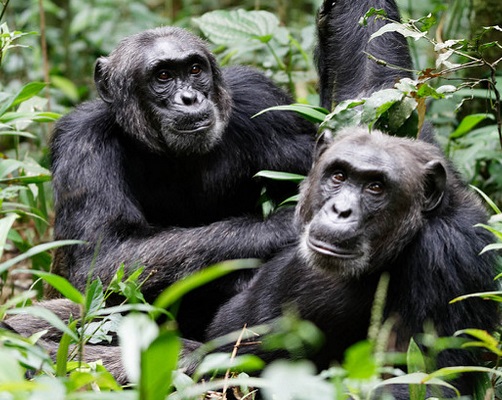
Chimpanzees in Africa
About Chimpanzees (Pan troglodytes)
Chimpanzees, commonly known as chimps, are native to sub-Saharan Africa and are among the most intelligent animals on Earth. They are highly adaptable and thrive in a wide range of habitats, including rainforests, montane forests, savanna grasslands, and swamps.
Chimpanzees belong to the great ape family, which also includes gorillas and orangutans. There are two chimpanzee species:
- Common Chimpanzee (Pan troglodytes)
- Bonobo (Pan paniscus) – found only in the Democratic Republic of Congo
The Common Chimpanzee is further divided into four sub-species:
- Central Chimpanzee
- Eastern Chimpanzee
- Western Chimpanzee
- Nigeria–Cameroon Chimpanzee
Chimpanzees and Human Evolution
Chimpanzees and bonobos are humans’ closest living relatives. Scientists believe that humans, chimps, and bonobos share a common ancestor that lived about 7 million years ago, while chimps and bonobos split into separate species roughly 1 million years ago.
This close genetic relationship explains many similarities in behavior, intelligence, emotions, and social structure.
Physical Characteristics of Chimpanzees
Chimpanzees have:
- Bare faces, palms, fingers, and toes
- Black or brown body hair
- Long arms that extend beyond their legs
Male chimps can weigh up to 70 kg, while females weigh between 27–50 kg. Despite being smaller than humans, chimps are up to 1.5 times stronger. An adult chimp can stand upright at nearly 5 feet tall.
In the wild, most chimpanzees live about 25 years, although some may reach 60 years. In captivity, they can live up to 70 years. Aging chimps often develop grey hair around the chin or bald patches.
Feeding Behavior and Diet
Chimpanzees spend time both on the ground and in trees. They begin feeding at dawn, targeting fruit-rich areas. Most feeding occurs in the treetops, followed by afternoon resting periods.
Their diet consists mainly of:
- Fruits
- Leaves, bark, seeds, and stems
- Blossoms
Although primarily herbivorous, chimpanzees also consume insects, honey, soil, birds, and small mammals. Meat accounts for only about 2% of their diet. Chimps hunt cooperatively, targeting species such as colobus monkeys, bushbabies, warthogs, and small antelopes.
Chimpanzee Intelligence and Tool Use
Chimpanzees are the most intelligent primates after humans. They use and manufacture tools such as:
- Sticks to extract termites
- Stones to crack nuts
- Leaf sponges to collect water
- Spears to hunt small mammals
They also demonstrate advanced cognitive abilities, including problem-solving, memory, cooperation, laughter, empathy, and self-awareness. Chimps are one of the few animals known to pass the mirror self-recognition test.
Social Life and Community Structure
Chimpanzees live in large, complex communities of 15 to 150 individuals. These communities split into smaller groups for feeding, hunting, and patrolling territory but reunite regularly.
Leadership is shared among several males, with a dominant male maintaining power through alliances rather than absolute control. Political maneuvering, coalition-building, and competition are common within chimp societies.
Note: Every chimpanzee builds a new sleeping nest each night, except infants who share nests with their mothers.
Communication Among Chimpanzees
Chimpanzees communicate using:
- Vocal sounds (hoots, grunts, barks)
- Facial expressions
- Body postures and gestures
- Tree drumming and ground beating
Their loud and constant vocalizations make chimpanzee trekking especially exciting, as groups can often be heard long before they are seen.
Mating and Reproduction
Female chimpanzees reach sexual maturity at about 13 years, while males mature around 16 years. Females enter oestrus once a month and display visible swelling to signal fertility.
Unlike gorillas, no single male controls mating rights. Females mate with multiple males, reducing infanticide risk and increasing social support. Gestation lasts about 8 months, and births usually produce one infant.
Mothers form strong bonds with their young, providing care, protection, and education for many years. Infants are weaned between 6 and 9 years, and females give birth only once every five years.
Aggression and Conflict
Chimpanzees are more aggressive than gorillas, particularly males. They are known to organize territorial raids against neighboring chimp communities, sometimes resulting in fatalities.
While generally avoiding humans, chimps can become dangerous near human settlements, especially where habitats overlap. Their unpredictable nature makes guided chimpanzee trekking essential.
Chimpanzee Conservation Status
Once numbering over 1 million, fewer than 300,000 chimpanzees remain in the wild today. They are listed as Endangered by the IUCN.
Major threats include:
- Habitat destruction
- Poaching and bushmeat trade
- Disease transmission
- Snares and traps
- Illegal wildlife trade
Conservation organizations such as the Jane Goodall Institute, WWF, and African Wildlife Foundation (AWF) work tirelessly to protect chimpanzees through habitat preservation, community engagement, and education.
How You Can Help Protect Chimpanzees
You can support chimpanzee conservation by:
- Visiting chimps responsibly through eco-tourism
- Donating to conservation organizations
- Supporting local communities through sustainable travel
Tourism plays a vital role in funding conservation efforts and protecting chimpanzee habitats.
Where to See Chimpanzees in the Wild
The best countries for chimpanzee trekking in Africa include:
- Uganda
- Tanzania
- Rwanda
- Democratic Republic of Congo
Top Chimpanzee Trekking Destinations
- Kibale National Park (Uganda) – most popular
- Budongo Forest (Murchison Falls NP)
- Kyambura Gorge (Queen Elizabeth NP)
- Kalinzu & Semuliki Forests
- Nyungwe Forest (Rwanda)
- Virunga National Park (DRC)
Uganda also hosts the Ngamba Chimpanzee Sanctuary, ideal for conservation education and volunteer experiences.
Chimpanzee Trekking with Binary Safaris Adventures
At Binary Safaris Adventures, we offer expert-guided chimpanzee trekking safaris across East and Central Africa. Our tours focus on ethical wildlife encounters, conservation, and unforgettable experiences.
Contact us today to plan your chimpanzee trekking safari in Africa.